
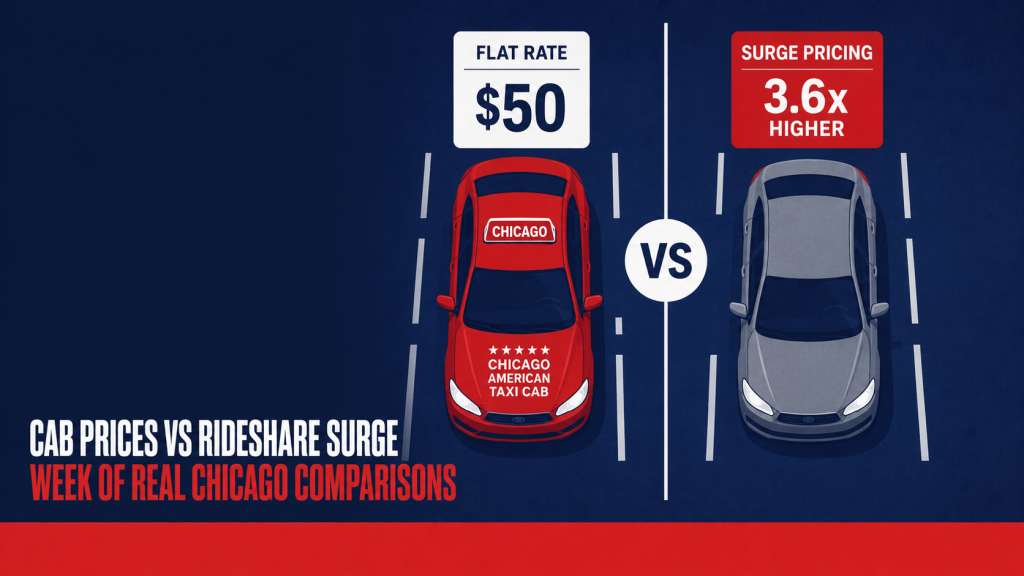
Cab prices on a flat-rate booking don’t move; rideshare prices do, and the gap between them is widest exactly when you most need a car. Across a normal Chicago week, the two land close together on quiet weekday afternoons and separate sharply on Friday nights, in bad weather and during airport arrival banks. If you want the flat figure for your own address before you compare anything, request a custom quote and you’ll have a number to hold the app against.
That’s the whole argument, and the rest of this is the detail behind it. I’m Roky Patel, and I’ve driven and dispatched Chicagoland airport work since 2011 — the seven scenarios below are the ones that come up week after week.
How often do rideshare prices exceed cab prices in Chicago?
Often enough that it’s a planning problem, not a curiosity. Rideshare pricing carries a demand multiplier that a flat rate simply doesn’t have, so any hour with more riders than drivers pushes app fares above cab prices. The multiplier is shown in the app before you accept, which is the one genuinely useful thing about it. Rideshare firms operate here as licensed transportation network providers, regulated by the City of Chicago’s Business Affairs and Consumer Protection department.
The pattern across a week looks like this.
| Scenario | Typical outcome |
| Tuesday 2 PM, Loop to Lincoln Park | Close. App often marginally cheaper |
| Weekday rush, 5 to 6:30 PM | Roughly even, surge appears intermittently |
| Friday evening, downtown outbound | Surge active, cab prices usually lower |
| Saturday bar close, River North | Surge at its peak, flat rate clearly lower |
| Rain or snow, any hour | Surge citywide, flat rate lower |
| O’Hare or Midway arrival bank | Surge plus a queue; flat rate lower and faster |
| Suburban pickup, any hour | Flat rate wins on availability, not just cost |
Off-peak, I’ll say plainly what the sheet says: a rideshare is frequently a few dollars under our cab prices for a short city hop at two in the afternoon. Anyone telling you cab prices always win is selling you something.
Takeaway: the honest answer changes by the hour, and it swings toward flat-rate cab prices every time demand spikes.
What sets cab prices on a flat-rate booking
The route, the town and the time of day. Nothing else. Our cab prices are published by suburb, agreed on the phone before the car is dispatched, and unchanged by whatever the traffic does afterward. There’s no meter running, so a 25-minute backup on the Kennedy costs you time and not money. The metered city alternative works on a different basis entirely, and the City of Chicago’s taxicab fare information sets out those regulated meter rates.
Two things sit on top of the flat rate, and both are stated up front. Tolls are added at cost, because the Tri-State and the Jane Addams bill the vehicle. And a $10 to $15 surcharge applies between 9:00 PM and 6:00 AM, depending on the pickup location.
Those are the only two additions to our cab prices, and that’s the entire structure. Compare it with a fare that is calculated fresh at the moment you tap, and you can see why the two behave differently under load: one is a quoted price, the other is a live one.
How much will a cab cost compared with an app on a Friday night
More predictable, and on a surged evening, usually less. How much will a cab cost is a question you can answer before you leave the house; the app version of the same question can only be answered at the moment you accept, and then only for the next few minutes.
Friday and Saturday evenings are where this stops being theoretical. Demand concentrates in a handful of areas at predictable hours, and app pricing responds to it in real time while flat-rate cab prices sit still. Cab prices quoted on Monday for a Friday pickup are the same cab prices you pay on Friday. The cost of asking how much will a cab cost twice, once at 9 PM and again at bar close, is that you get two different answers from the app and one from us.
Weather does the same thing faster. A hard rain that starts at 5:40 PM lifts app pricing across the whole city inside a few minutes, with no warning and no ceiling you can see in advance. Cab prices for the same trip are whatever they were that morning.
Takeaway: variable pricing costs you the most on the nights and in the weather when you have the least room to shop around.
Getting a cab fare quote you can budget against
Ask for the flat rate to your destination and get it confirmed before the booking closes. A cab fare quote should be a figure, not a range and not an “around”. If a dispatcher can’t state cab prices for your town on the phone, that operator doesn’t publish rates by suburb and you should assume the number can move.
Three things make a cab fare quote worth having.
- It’s the same figure whether the route takes 35 minutes or 70.
- It covers the vehicle, not each passenger, so four people split one number.
- It’s stated before you commit, so an expense claim can be filed against it in advance.
Distance is the main driver of cab rates out of the collar counties, and honest cab prices reflect it. If you book a cab from Park City you’re looking at a longer run down the Tri-State to O’Hare than a rider in Skokie, and the published rate for that town says so plainly rather than hiding it in a per-mile calculation you can’t check.
Where cab rates and app fares are genuinely close
Quiet weekday hours in the central city, single riders, short distances. In that window the two models converge, and I won’t pretend otherwise. Cab rates and app pricing are built on different logic, but on a 2 PM Tuesday run of two miles with no surge active, the numbers land within a few dollars of each other and the app is often the cheaper of the two.
The picture flips on three variables. Passenger count is the first: cab rates cover the car, so a group of four splits one flat rate while a larger app vehicle usually costs more per booking. Distance is the second, because long suburban runs are where published cab prices are most predictable. Time of day is the third and the strongest.
Airport work is the clearest case of all, and price is only half of it. A pre-booked car at Midway meets you at a fixed point rather than sending you across the terminal to a rideshare lot; where to meet your driver at Midway covers exactly where that is. On an arrival bank at 11 PM, that’s ten minutes and a known figure against a live quote and a walk.
How to use this before your next booking
Seven habits, drawn from the same week of comparisons.
- Check the multiplier in the app before you accept. Above roughly 1.5x, compare cab prices instead.
- Pre-book anything with a deadline. Advance booking removes both the surge and the wait-time gamble.
- For three or more passengers, compare per vehicle, not per person.
- In rain, snow or the first freeze of the season, assume surge is already live and skip the comparison.
- Ask for the flat rate and the surcharge window together, so overnight cab prices hold no surprises.
- Price the return leg separately. The multiplier that applied outbound rarely applies coming home.
- Keep the receipt if you’re expensing it; cash and all major cards are accepted either way.
Suburban riders should add one more. Confirm coverage before you compare anything, because a fare comparison is academic if no car will come. A rider in Green Oaks has fewer on-demand options at 4 AM than a rider in the Loop does, which is why the Green Oaks airport taxi page lists the flat rate and the coverage together.
Why predictable cab prices matter more than the lowest number
Because a fare you can state in advance is worth more than a fare that might be lower. If you’re expensing a ride, coordinating four people, or catching a 6 AM departure out of O’Hare, certainty is the product. A flat rate you can budget beats a quote that reprices while you’re locking the front door.
There’s a second cost to variable pricing that nobody puts on the invoice: the decision itself. App pricing makes you re-evaluate every trip, sometimes twice, sometimes at the curb in the rain. Published cab prices remove that step. You book once, and the number you were told is the number you pay, plus tolls and any night surcharge you already knew about.
Chicago American Taxi Cab is family run, operates 24/7, and serves 180-plus suburbs across Cook, DuPage, Kane, Lake, McHenry and Will counties, with drivers who’ve worked these roads for seven years or more. That’s the operational reason our cab prices can be quoted in advance at all.
Frequently Asked Questions
Are cab prices cheaper than rideshare in Chicago?
It depends on timing. Off-peak, a rideshare is often a few dollars cheaper. On Friday and Saturday nights, in rain or snow, and during airport arrival banks, flat-rate cab prices are usually lower because they can’t surge.
Do your cabs use a meter?
No. Rides run on published flat rates agreed before the trip, with tolls added at cost. Traffic changes how long the ride takes, not what it costs. Advance booking is required so the rate can be quoted.
How much will a cab cost from my suburb to O’Hare?
Ask for the published flat rate for your town when you book, or request a custom quote online. The figure depends on distance and time of day, and it’s confirmed before the car is dispatched.
When is rideshare surge worst in Chicago?
Friday and Saturday evenings, at bar close in areas like River North, during rain and snow, and immediately after major events and airport arrival banks. The multiplier shows in the app before you accept.
Is there a night surcharge on cab prices?
Yes. A $10 to $15 surcharge applies between 9:00 PM and 6:00 AM depending on the pickup location. Ask the dispatcher which figure applies to your address when you book.
What payment methods can I use?
Cash and all major credit and debit cards. Tolls are added to the agreed flat rate at cost, and the total is known before the trip rather than calculated at the end of it.
How far ahead should I book to avoid surge pricing?
Book the night before for airport runs and any departure before 6 AM. Advance booking locks the flat rate and the vehicle, so demand at your pickup hour doesn’t affect either one.
Book a flat-rate ride
Give the pickup address, the time and the passenger count, and the rate is agreed before the car leaves. Chicago American Taxi Cab runs flat-rate airport work to O’Hare, Midway and the Loop, 24 hours a day, across the city and 180-plus suburbs. Call or text +1 (224) 622-7653 and compare cab prices with a real figure rather than a live quote.
PHP: 2026-08-27 01:59:54 [notice X 0][/home/oharetaxiservice/public_html/chicagoamericantaxicab.com/wp-content/plugins/elementor/modules/global-classes/atomic-global-styles.php::410] Elementor\Modules\GlobalClasses\Atomic_Global_Styles::get_cache_root_key(): Implicitly marking parameter $key as nullable is deprecated, the explicit nullable type must be used instead [array ( ‘trace’ => ‘ #0: Elementor\Core\Logger\Manager -> shutdown() ‘, )]