
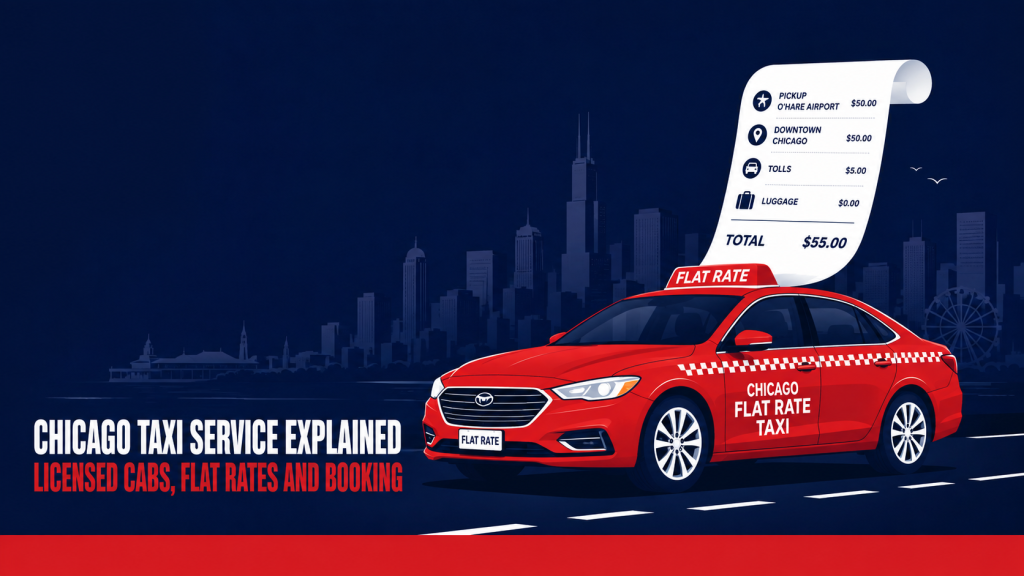
A Chicago taxi service is a licensed, commercially plated and commercially insured car operation, staffed by vetted drivers, that carries passengers for a regulated or published fare. In the suburbs it works by advance booking at a flat rate rather than by street hail on a meter. That distinction is the one that changes what you pay and how you plan.
This guide explains what sits behind the licence: the plates, the insurance, the driver checks, and the practical differences a passenger actually notices at 4 AM on a driveway in Wilmette. I have worked in this trade since 2011 and most of it is invisible until the day it matters.
What a Chicago taxi service actually is
A Chicago taxi service is a for-hire ground transport operator whose vehicles carry commercial registration, commercial insurance and, in the city, a municipal medallion or licence. Suburban operators work under municipal and county licensing rather than the city medallion system, which is why their pricing model differs.
The city and the suburbs run two different products under the same word. In the city you hail a metered cab. In the suburbs you book a car in advance at a published flat rate, because a passing taxi Chicago residents can flag simply does not exist on a residential street in Medinah at 4 AM.
Both are a Chicago taxi service. Only one of them makes sense for an airport run from a suburban address, and the flat rate model exists because the metered model cannot price a 30-mile trip honestly at the point of booking.
A Chicago taxi service is defined by licensing and insurance, not by the paint scheme or the app.
What makes a Chicago taxi service different from a rideshare app?
Three things: the licensing standard the vehicle must meet, the insurance that covers you in it, and whether the price can change after you agree to it. A Chicago taxi service works to a commercial standard on all three, and a rideshare platform works to a different one.
Commercial plates and inspection
Taxi vehicles carry commercial plates and are inspected as commercial vehicles. That means scheduled mechanical checks rather than an annual emissions test. A Chicago taxi service that fails an inspection takes the car off the road, which is a cost the operator absorbs rather than a cost you discover.
Insurance
Commercial livery insurance covers passengers as passengers, at commercial limits, at all times the vehicle is in service. Personal policies with rideshare endorsements work differently and depend on which phase of a trip is active. You will never think about this until you need to, and by then the policy is already whatever it was.
Price certainty
A rideshare fare is computed by an algorithm that responds to demand. A Chicago taxi service quoting a flat rate commits to a number in advance and holds it through a snowstorm and a ground stop. Our comparison of why a flat rate usually wins covers the arithmetic on airport runs.
Driver vetting and what seven years on the road buys
A Chicago taxi service vets drivers before they carry anyone: licence history, background checks and local knowledge, followed by supervised time on real routes. Our drivers have worked Chicago roads for seven years or more, and that experience shows up in specific, unglamorous ways.
It looks like knowing the Tri-State northbound needs an extra 20 minutes on a Friday afternoon, and that a Chicago taxi service booking at 3 PM should assume it. It looks like knowing which O’Hare terminal door clears fastest at 6 PM, and that the Ohio Street feeder ramp is where the Kennedy stops moving first. A driver who learned the network from an application does not have any of that.
It also looks like judgement. A driver who has done 4 AM airport work for years knows to arrive five minutes early and wait quietly rather than sounding the horn in a residential street. That is the sort of taxi Chicago suburbs actually want on the driveway before dawn. Small things, but a Chicago taxi service is mostly made of small things done consistently.
The difference you feel between operators is nearly always driver experience rather than vehicle age.
How flat rate pricing works in the suburbs
A taxi service in Chicago suburbs publishes a fixed fare per town rather than running a meter, so the figure quoted at booking is the figure you pay. Tolls are added and itemised. A surcharge of $10 to $15 applies between 9:00 PM and 6:00 AM depending on location.
| Flat rate | Meter | Surge pricing | |
| Price known at booking | Yes | No | Only at that moment |
| Rises in traffic | No | Yes | Sometimes |
| Rises at peak demand | No | No | Frequently |
| Tolls | Added, itemised | Added | Usually absorbed |
| Night charge | $10 to $15, stated upfront | Varies | Inside the multiplier |
What the table does not capture is planning. A Chicago taxi service that quotes a fixed number lets you book the ride before you book the flight, because the ground cost is already known. That ordering sounds trivial until you have priced a family of four.
Payment is cash or all major cards at the end of the ride. Nothing is charged at booking and no card is held on file, which is a deliberate choice rather than a technical limitation.
A Chicago airport taxi run is the clearest case, and it is where this model earns its reputation. On a 30-mile trip with tolls, a meter produces a number nobody can forecast, and a flat rate produces one you can put in an expense claim before you travel. The flat rate taxi from Wilmette page shows how a north shore run is quoted to O’Hare. A Chicago taxi service publishing that figure openly is making a commitment it has to honour on the worst traffic day of the year, not just the best.
Booking a Chicago taxi service in the suburbs
Call or text with your address, date, time, destination and passenger count, and for airport work the flight number. Advance booking is required. A Chicago taxi service in the suburbs dispatches to named addresses at named times, so there is nothing to hail and nothing to wait for on a corner.
The information a dispatcher needs is deliberately short, because long forms lose people. A taxi service in Chicago suburbs runs on five facts and a phone number.
Twenty-four hours ahead is comfortable. Book 48 hours ahead for groups, oversized luggage or any pickup before 5 AM, which is the busiest window in suburban airport work by a wide margin. Dispatch runs 24 hours a day, seven days a week.
Give the flight number rather than a landing time for arrivals. That single detail lets a Chicago taxi service track the aircraft and move the pickup without a phone call from you. A taxi service in Chicago suburbs that asks for the flight number is telling you it intends to track it.
Chicago American Taxi Cab covers more than 180 suburbs across Cook, DuPage, Kane, Lake, McHenry and Will counties, serving O’Hare, Midway and the Chicago Loop. The Winnetka to Midway fares page is a useful example of a cross-metro run, since Winnetka to MDW crosses the entire city and still holds a single published rate.
What to check before choosing an operator
Ask four questions and you will know what you are dealing with: is the vehicle commercially plated and insured, is the rate published for your town, are tolls and night surcharges stated upfront, and does dispatch answer at 3 AM. A Chicago taxi service that answers all four plainly is usually a safe booking.
Ask about hours as well. A Chicago taxi service that only answers between 8 AM and 6 PM cannot help with the 4 AM departures that make up most suburban airport work, and that gap is easy to miss until you need it.
Then ask about vehicle capacity. Four passengers with four checked bags do not fit a sedan, and a Chicago taxi service that takes that detail at booking sends a van the first time. A Chicago airport taxi booked without mentioning a car seat is a problem discovered on a driveway at 4 AM.
A good operator will also tell you when a Chicago airport taxi is the wrong choice for your trip. Finally, be honest about alternatives. For one traveller with a carry-on, the Blue Line to O’Hare is cheaper than any cab and always will be. A Chicago taxi service wins on door-to-door time, luggage, early departures and any group of two or more. Further detail sits in our common booking questions.
Frequently Asked Questions
What licences does a Chicago taxi service need?
Commercial vehicle registration, commercial livery insurance and municipal or county for-hire licensing. City medallion cabs operate under a separate Chicago licensing regime.
How is a flat rate different from a meter?
A flat rate is a published fare per town, fixed at booking. A meter counts distance and idle time, so traffic changes the total after you commit to the trip.
Do I have to book in advance?
Yes. Suburban operators dispatch to named addresses at named times rather than cruising for hails, so there is no on-demand pickup outside the city core.
When does the night surcharge apply?
Between 9:00 PM and 6:00 AM, at $10 to $15 depending on location. It is quoted when you book rather than added to the total afterwards.
Are tolls included in the fare?
No. Tolls are added and itemised separately from the flat rate, so you see exactly what the road charged rather than an averaged estimate.
Which suburbs are covered?
More than 180 across Cook, DuPage, Kane, Lake, McHenry and Will counties. Chicago airport taxi work runs to O’Hare, Midway and the Loop in both directions.
Can I book a taxi Chicago suburbs residents use for non-airport trips?
Yes. Medical appointments, events, corporate travel and intercity runs are all booked the same way, at a published rate agreed before the trip begins.
Call or text +1 (224) 622-7653 with your address, destination and timing, and you will have a flat rate and a confirmed pickup from a licensed Chicago taxi service in one conversation.